After a Period of Extinction a Cr Occurs Again When an Ucs Is Presented This Is Called
Classical conditioning (also known equally Pavlovian or respondent workout) is a behavioral procedure in which a biologically stiff stimulus (e.grand. nutrient) is paired with a previously neutral stimulus (e.g. a bong). It also refers to the learning process that results from this pairing, through which the neutral stimulus comes to elicit a response (e.yard. salivation) that is normally like to the i elicited by the potent stimulus.
Classical conditioning is distinct from operant conditioning (also called instrumental conditioning), through which the force of a voluntary behavior is modified by reinforcement or punishment. Still, classical workout can affect operant conditioning in diverse ways; notably, classically conditioned stimuli may serve to reinforce operant responses.
Classical workout was first studied in item past Ivan Pavlov, who conducted experiments with dogs and published his findings in 1897. During the Russian physiologist's study of digestion, Pavlov observed that the dogs serving as his subjects drooled when they were beingness served meat.[1]
Classical workout is a basic behavioral machinery, and its neural substrates are now beginning to be understood. Though information technology is sometimes hard to distinguish classical conditioning from other forms of associative learning (eastward.g. instrumental learning and human associative memory), a number of observations differentiate them, especially the contingencies whereby learning occurs.[two]
Together with operant conditioning, classical conditioning became the foundation of behaviorism, a school of psychology which was ascendant in the mid-20th century and is all the same an important influence on the practice of psychological therapy and the study of animal behavior. Classical workout has been applied in other areas besides. For example, information technology may affect the body'south response to psychoactive drugs, the regulation of hunger, enquiry on the neural footing of learning and retention, and in certain social phenomena such every bit the false consensus effect.[3]
Definition [edit]
Classical conditioning occurs when a conditioned stimulus (CS) is paired with an unconditioned stimulus (United states). Ordinarily, the conditioned stimulus is a neutral stimulus (due east.g., the sound of a tuning fork), the unconditioned stimulus is biologically potent (e.g., the taste of food) and the unconditioned response (UR) to the unconditioned stimulus is an unlearned reflex response (eastward.g., salivation). Subsequently pairing is repeated the organism exhibits a conditioned response (CR) to the conditioned stimulus when the conditioned stimulus is presented alone. (A conditioned response may occur after merely one pairing.) Thus, unlike the UR, the CR is caused through experience, and information technology is besides less permanent than the UR.[4]
Usually the conditioned response is similar to the unconditioned response, but sometimes it is quite different. For this and other reasons, virtually learning theorists suggest that the conditioned stimulus comes to bespeak or predict the unconditioned stimulus, and keep to analyze the consequences of this signal.[five] Robert A. Rescorla provided a clear summary of this change in thinking, and its implications, in his 1988 article "Pavlovian conditioning: It's non what y'all think information technology is".[6] Despite its widespread acceptance, Rescorla's thesis may not exist defensible.[7]
Classical conditioning differs from operant or instrumental workout: in classical conditioning, behaviors are modified through the association of stimuli every bit described above, whereas in operant workout behaviors are modified by the event they produce (i.e., reward or punishment).[8]
Procedures [edit]
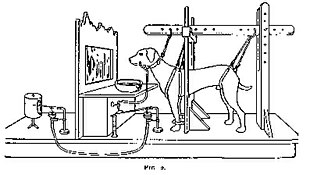
Ivan Pavlov enquiry on dog'southward reflex setup
Pavlov'south inquiry [edit]
The best-known and about thorough early piece of work on classical workout was washed by Ivan Pavlov, although Edwin Twitmyer published some related findings a year earlier.[9] During his research on the physiology of digestion in dogs, Pavlov developed a procedure that enabled him to study the digestive processes of animals over long periods of time. He redirected the creature's digestive fluids outside the body, where they could be measured. Pavlov noticed that his dogs began to salivate in the presence of the technician who normally fed them, rather than simply salivating in the presence of nutrient. Pavlov chosen the dogs' anticipatory salivation "psychic secretion". Putting these informal observations to an experimental test, Pavlov presented a stimulus (east.g. the sound of a metronome) and then gave the dog nutrient; after a few repetitions, the dogs started to salivate in response to the stimulus. Pavlov concluded that if a particular stimulus in the domestic dog's environment was present when the domestic dog was given food then that stimulus could become associated with food and cause salivation on its own.

Classical Workout Diagram
Terminology [edit]
In Pavlov's experiments the unconditioned stimulus (Us) was the food because its effects did non depend on previous experience. The metronome'southward sound is originally a neutral stimulus (NS) considering it does non elicit salivation in the dogs. After workout, the metronome'south sound becomes the conditioned stimulus (CS) or provisional stimulus; considering its effects depend on its clan with food.[x] Likewise, the responses of the dog follow the aforementioned conditioned-versus-unconditioned system. The conditioned response (CR) is the response to the conditioned stimulus, whereas the unconditioned response (UR) corresponds to the unconditioned stimulus.
Pavlov reported many basic facts well-nigh workout; for example, he plant that learning occurred most quickly when the interval between the CS and the appearance of the U.s. was relatively brusk.[eleven]
As noted before, it is often thought that the conditioned response is a replica of the unconditioned response, but Pavlov noted that saliva produced by the CS differs in limerick from that produced by the US. In fact, the CR may be any new response to the previously neutral CS that can be clearly linked to experience with the conditional relationship of CS and United states of america.[6] [8] Information technology was likewise thought that repeated pairings are necessary for workout to emerge, but many CRs tin can be learned with a single trial, peculiarly in fear conditioning and taste aversion learning.
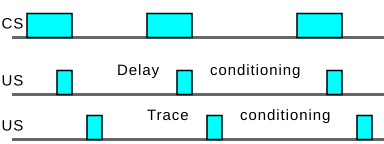
Diagram representing forward conditioning. The time interval increases from left to right.
Forward conditioning [edit]
Learning is fastest in forrad conditioning. During forward conditioning, the onset of the CS precedes the onset of the United states in order to indicate that the United states of america will follow.[12] [13] : 69 2 common forms of frontwards conditioning are delay and trace conditioning.
- Filibuster conditioning: In delay conditioning, the CS is presented and is overlapped past the presentation of the U.s.a.. For case, if a person hears a buzzer for five seconds, during which time air is puffed into their eye, the person volition blink. After several pairings of the buzzer and the puff, the person will blink at the sound of the buzzer lone. This is filibuster workout.
- Trace workout: During trace conditioning, the CS and United states of america do non overlap. Instead, the CS begins and ends earlier the US is presented. The stimulus-free period is chosen the trace interval or the conditioning interval. If in the above cablegram example, the puff came a 2d later on the sound of the buzzer stopped, that would exist trace conditioning, with a trace or workout interval of one second.
Simultaneous workout [edit]
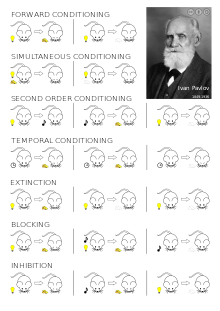
Classical conditioning procedures and effects
During simultaneous conditioning, the CS and US are presented and terminated at the same time. For example: If a person hears a bell and has air puffed into their eye at the aforementioned time, and repeated pairings like this led to the person blinking when they hear the bell despite the puff of air being absent, this demonstrates that simultaneous workout has occurred. 
Second-club and higher-guild conditioning [edit]
Second-order or higher-society workout follow a two-stride process. First a neutral stimulus ("CS1") comes to bespeak a The states through forwards conditioning. And so a second neutral stimulus ("CS2") is paired with the starting time (CS1) and comes to yield its ain conditioned response.[13] : 66 For instance: A bong might be paired with food until the bong elicits salivation. If a light is then paired with the bell, then the light may come to elicit salivation likewise. The bell is the CS1 and the nutrient is the US. The lite becomes the CS2 once it is paired with the CS1.

Astern conditioning [edit]
Astern workout occurs when a CS immediately follows a US.[12] Unlike the usual conditioning procedure, in which the CS precedes the Us, the conditioned response given to the CS tends to be inhibitory. This presumably happens because the CS serves as a indicate that the US has ended, rather than as a indicate that the U.s. is about to appear.[13] : 71 For example, a puff of air directed at a person's eye could exist followed by the sound of a buzzer.
Temporal conditioning [edit]
In temporal conditioning, a US is presented at regular intervals, for example every x minutes. Conditioning is said to have occurred when the CR tends to occur shortly before each U.s.a.. This suggests that animals have a biological clock that can serve as a CS. This method has likewise been used to study timing ability in animals (encounter Fauna noesis).
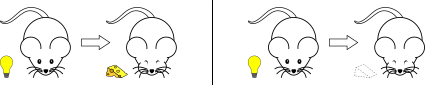
The example below shows the temporal conditioning, as US such as food to a hungry mouse is simply delivered on a regular time schedule such as every thirty seconds. After sufficient exposure the mouse will brainstorm to salivate only earlier the food delivery. This then makes information technology temporal conditioning equally it would appear that the mouse is conditioned to the passage of fourth dimension. 
Zero contingency procedure [edit]
In this procedure, the CS is paired with the US, but the US also occurs at other times. If this occurs, information technology is predicted that the U.s. is probable to happen in the absenteeism of the CS. In other words, the CS does not "predict" the United states. In this case, workout fails and the CS does not come to elicit a CR.[fourteen] This finding – that prediction rather than CS-The states pairing is the cardinal to conditioning – greatly influenced subsequent conditioning enquiry and theory.
Extinction [edit]
In the extinction procedure, the CS is presented repeatedly in the absenteeism of a US. This is washed later a CS has been conditioned by one of the methods in a higher place. When this is done, the CR frequency somewhen returns to pre-training levels. Still, extinction does non eliminate the effects of the prior conditioning. This is demonstrated by spontaneous recovery – when there is a sudden advent of the (CR) subsequently extinction occurs – and other related phenomena (see "Recovery from extinction" below). These phenomena can be explained by postulating aggregating of inhibition when a weak stimulus is presented.
Phenomena observed [edit]
Acquisition [edit]
During acquisition, the CS and US are paired as described to a higher place. The extent of conditioning may be tracked by test trials. In these test trials, the CS is presented alone and the CR is measured. A single CS-The states pairing may suffice to yield a CR on a exam, simply usually a number of pairings are necessary and there is a gradual increase in the conditioned response to the CS. This repeated number of trials increment the strength and/or frequency of the CR gradually. The speed of conditioning depends on a number of factors, such as the nature and strength of both the CS and the US, previous experience and the animal's motivational state.[5] [8] The process slows downward as it nears completion.[15]
Extinction [edit]
If the CS is presented without the US, and this process is repeated oft enough, the CS will eventually cease eliciting a CR. At this bespeak the CR is said to be "extinguished."[five] [16]

External inhibition [edit]
External inhibition may be observed if a strong or unfamiliar stimulus is presented just before, or at the same fourth dimension as, the CS. This causes a reduction in the conditioned response to the CS.
Recovery from extinction [edit]
Several procedures lead to the recovery of a CR that had been first conditioned and so extinguished. This illustrates that the extinction procedure does non eliminate the issue of workout.[8] These procedures are the following:
- Reacquisition: If the CS is again paired with the US, a CR is again caused, simply this second acquisition commonly happens much faster than the offset ane.
- Spontaneous recovery: Spontaneous recovery is defined as the reappearance of a previously extinguished conditioned response after a rest period. That is, if the CS is tested at a later time (for instance an hour or a day) after extinction information technology will again elicit a CR. This renewed CR is usually much weaker than the CR observed prior to extinction.
- Disinhibition: If the CS is tested simply after extinction and an intense but associatively neutral stimulus has occurred, at that place may be a temporary recovery of the conditioned response to the CS.
- Reinstatement: If the US used in conditioning is presented to a subject in the same place where conditioning and extinction occurred, but without the CS being nowadays, the CS oft elicits a response when information technology is tested later.
- Renewal: Renewal is a reemergence of a conditioned response following extinction when an animal is returned to the surround in which the conditioned response was caused.
Stimulus generalization [edit]
Stimulus generalization is said to occur if, after a detail CS has come to elicit a CR, a like test stimulus is found to elicit the same CR. Usually the more similar the test stimulus is to the CS the stronger the CR will be to the test stimulus.[five] Conversely, the more than the exam stimulus differs from the CS, the weaker the CR will exist, or the more it will differ from that previously observed.
Stimulus discrimination [edit]
One observes stimulus discrimination when i stimulus ("CS1") elicits one CR and another stimulus ("CS2") elicits either another CR or no CR at all. This can exist brought near by, for case, pairing CS1 with an constructive Us and presenting CS2 with no United states.[5]
Latent inhibition [edit]
Latent inhibition refers to the ascertainment that it takes longer for a familiar stimulus to get a CS than it does for a novel stimulus to become a CS, when the stimulus is paired with an effective US.[v]
Conditioned suppression [edit]
This is ane of the most common means to measure the strength of learning in classical conditioning. A typical example of this process is as follows: a rat showtime learns to press a lever through operant workout. And so, in a series of trials, the rat is exposed to a CS, a light or a noise, followed by the U.s., a balmy electric daze. An clan between the CS and The states develops, and the rat slows or stops its lever pressing when the CS comes on. The rate of pressing during the CS measures the strength of classical workout; that is, the slower the rat presses, the stronger the association of the CS and the U.s.a.. (Slow pressing indicates a "fright" conditioned response, and it is an example of a conditioned emotional response; see section below.)
Conditioned inhibition [edit]
Typically, three phases of conditioning are used.
Phase ane [edit]
A CS (CS+) is paired with a United states of america until asymptotic CR levels are reached.
Phase 2 [edit]
CS+/U.s. trials are continued, merely these are interspersed with trials on which the CS+ is paired with a second CS, (the CS-) but not with the US (i.due east. CS+/CS- trials). Typically, organisms evidence CRs on CS+/Us trials, but finish responding on CS+/CS− trials.
Phase 3 [edit]
- Summation test for conditioned inhibition: The CS- from phase ii is presented together with a new CS+ that was conditioned as in phase i. Conditioned inhibition is constitute if the response is less to the CS+/CS- pair than it is to the CS+ alone.
- Retardation test for conditioned inhibition: The CS- from phase 2 is paired with the Us. If conditioned inhibition has occurred, the charge per unit of acquisition to the previous CS− should be less than the rate of conquering that would be institute without the phase 2 treatment.
Blocking [edit]
This form of classical workout involves two phases.
Phase 1 [edit]
A CS (CS1) is paired with a The states.
Stage 2 [edit]
A compound CS (CS1+CS2) is paired with a Us.
Test [edit]
A separate test for each CS (CS1 and CS2) is performed. The blocking event is observed in a lack of conditional response to CS2, suggesting that the kickoff phase of preparation blocked the acquisition of the second CS. 
Theories [edit]
Information sources [edit]
Experiments on theoretical issues in conditioning take by and large been done on vertebrates, especially rats and pigeons. However, workout has also been studied in invertebrates, and very important data on the neural basis of conditioning has come from experiments on the sea slug, Aplysia.[five] Most relevant experiments have used the classical conditioning procedure, although instrumental (operant) workout experiments have also been used, and the strength of classical conditioning is often measured through its operant effects, as in conditioned suppression (see Phenomena section in a higher place) and autoshaping.
Stimulus-substitution theory [edit]
According to Pavlov, conditioning does non involve the acquisition of any new behavior, but rather the trend to respond in sometime means to new stimuli. Thus, he theorized that the CS simply substitutes for the US in evoking the reflex response. This explanation is called the stimulus-commutation theory of conditioning.[xiii] : 84 A disquisitional problem with the stimulus-commutation theory is that the CR and UR are not e'er the same. Pavlov himself observed that a canis familiaris's saliva produced as a CR differed in composition from that produced as a UR.[9] The CR is sometimes fifty-fifty the opposite of the UR. For example: the unconditional response to electric daze is an increase in heart rate, whereas a CS that has been paired with the electric shock elicits a subtract in eye rate. (However, it has been proposed[ by whom? ] that only when the UR does not involve the cardinal nervous system are the CR and the UR opposites.)
Rescorla–Wagner model [edit]
The Rescorla–Wagner (R–W) model[8] [17] is a relatively simple notwithstanding powerful model of workout. The model predicts a number of important phenomena, only it also fails in important means, thus leading to a number of modifications and culling models. Even so, because much of the theoretical research on workout in the past xl years has been instigated by this model or reactions to information technology, the R–W model deserves a brief clarification here.[18] [13] : 85
The Rescorla-Wagner model argues that there is a limit to the corporeality of conditioning that can occur in the pairing of two stimuli. One determinant of this limit is the nature of the US. For example: pairing a bell with a juicy steak is more probable to produce salivation than pairing the bell with a piece of dry bread, and dry bread is likely to work better than a piece of paper-thin. A key idea behind the R–W model is that a CS signals or predicts the US. One might say that before conditioning, the subject is surprised by the United states of america. However, after conditioning, the subject is no longer surprised, because the CS predicts the coming of the U.s.a.. (Notation that the model tin can be described mathematically and that words similar predict, surprise, and await are only used to assist explain the model.) Hither the workings of the model are illustrated with brief accounts of acquisition, extinction, and blocking. The model also predicts a number of other phenomena, run across chief article on the model.
Equation [edit]

This is the Rescorla-Wagner equation. It specifies the corporeality of learning that will occur on a single pairing of a conditioning stimulus (CS) with an unconditioned stimulus (Usa). The above equation is solved repeatedly to predict the class of learning over many such trials.
In this model the caste of learning is measured past how well the CS predicts the U.s., which is given by the "associative forcefulness" of the CS. In the equation, V represents the current associative strength of the CS, and ∆V is the modify in this strength that happens on a given trial. ΣV is the sum of the strengths of all stimuli nowadays in the situation. λ is the maximum associative strength that a given US will support; its value is usually fix to 1 on trials when the US is present, and 0 when the US is absent-minded. α and β are constants related to the salience of the CS and the speed of learning for a given United states. How the equation predicts various experimental results is explained in following sections. For further details, see the main article on the model.[13] : 85–89
R–W model: acquisition [edit]
The R–Due west model measures workout by assigning an "associative strength" to the CS and other local stimuli. Before a CS is conditioned it has an associative strength of zippo. Pairing the CS and the US causes a gradual increase in the associative strength of the CS. This increase is determined past the nature of the US (eastward.g. its intensity).[13] : 85–89 The corporeality of learning that happens during any single CS-US pairing depends on the departure between the total associative strengths of CS and other stimuli present in the situation (ΣV in the equation), and a maximum set by the US (λ in the equation). On the first pairing of the CS and US, this deviation is large and the associative strength of the CS takes a big pace upwards. As CS-US pairings accumulate, the US becomes more predictable, and the increase in associative strength on each trial becomes smaller and smaller. Finally, the difference between the associative forcefulness of the CS (plus any that may accrue to other stimuli) and the maximum strength reaches zero. That is, the US is fully predicted, the associative strength of the CS stops growing, and workout is complete.
R–W model: extinction [edit]

Comparison the acquaintance strength by R-Westward model in Learning
The associative procedure described past the R–Westward model besides accounts for extinction (see "procedures" to a higher place). The extinction procedure starts with a positive associative strength of the CS, which means that the CS predicts that the US will occur. On an extinction trial the Us fails to occur afterwards the CS. As a result of this "surprising" outcome, the associative force of the CS takes a footstep downward. Extinction is complete when the strength of the CS reaches naught; no Usa is predicted, and no US occurs. Notwithstanding, if that aforementioned CS is presented without the United states but accompanied by a well-established conditioned inhibitor (CI), that is, a stimulus that predicts the absence of a US (in R-W terms, a stimulus with a negative associate strength) then R-W predicts that the CS will not undergo extinction (its 5 will not decrease in size).
R–W model: blocking [edit]
The most important and novel contribution of the R–Due west model is its supposition that the conditioning of a CS depends not just on that CS solitary, and its relationship to the U.s.a., but also on all other stimuli nowadays in the conditioning situation. In particular, the model states that the United states is predicted past the sum of the associative strengths of all stimuli nowadays in the workout situation. Learning is controlled by the difference between this total associative strength and the strength supported by the The states. When this sum of strengths reaches a maximum set by the United states, conditioning ends as just described.[13] : 85–89
The R–W explanation of the blocking miracle illustrates i effect of the supposition simply stated. In blocking (encounter "phenomena" above), CS1 is paired with a U.s. until workout is complete. Then on additional conditioning trials a second stimulus (CS2) appears together with CS1, and both are followed by the US. Finally CS2 is tested and shown to produce no response because learning nigh CS2 was "blocked" by the initial learning about CS1. The R–W model explains this by maxim that later on the initial conditioning, CS1 fully predicts the US. Since there is no difference between what is predicted and what happens, no new learning happens on the additional trials with CS1+CS2, hence CS2 later yields no response.
Theoretical problems and alternatives to the Rescorla–Wagner model [edit]
One of the principal reasons for the importance of the R–W model is that it is relatively unproblematic and makes clear predictions. Tests of these predictions have led to a number of important new findings and a considerably increased understanding of conditioning. Some new information has supported the theory, but much has non, and information technology is by and large agreed that the theory is, at best, too simple. However, no single model seems to account for all the phenomena that experiments have produced.[8] [xix] Post-obit are brief summaries of some related theoretical bug.[18]
Content of learning [edit]
The R–Due west model reduces conditioning to the association of a CS and U.s.a., and measures this with a single number, the associative forcefulness of the CS. A number of experimental findings bespeak that more than is learned than this. Among these are ii phenomena described earlier in this article
- Latent inhibition: If a subject is repeatedly exposed to the CS before conditioning starts, then conditioning takes longer. The R–West model cannot explain this considering preexposure leaves the strength of the CS unchanged at cipher.
- Recovery of responding after extinction: It appears that something remains after extinction has reduced associative strength to zero because several procedures cause responding to reappear without farther conditioning.[8]
Role of attention in learning [edit]
Latent inhibition might happen considering a subject stops focusing on a CS that is seen frequently earlier it is paired with a The states. In fact, changes in attending to the CS are at the heart of two prominent theories that endeavour to cope with experimental results that give the R–W model difficulty. In one of these, proposed by Nicholas Mackintosh,[20] the speed of conditioning depends on the amount of attention devoted to the CS, and this amount of attending depends in turn on how well the CS predicts the US. Pearce and Hall proposed a related model based on a different attentional principle[21] Both models take been extensively tested, and neither explains all the experimental results. Consequently, diverse authors take attempted hybrid models that combine the two attentional processes. Pearce and Hall in 2010 integrated their attentional ideas and fifty-fifty suggested the possibility of incorporating the Rescorla-Wagner equation into an integrated model.[8]
Context [edit]
Every bit stated before, a cardinal idea in workout is that the CS signals or predicts the US (see "zero contingency procedure" above). Withal, for example, the room in which conditioning takes place besides "predicts" that the The states may occur. Nevertheless, the room predicts with much less certainty than does the experimental CS itself, because the room is also there between experimental trials, when the US is absent. The role of such context is illustrated by the fact that the dogs in Pavlov'southward experiment would sometimes start salivating every bit they approached the experimental apparatus, before they saw or heard whatsoever CS.[15] Such and so-called "context" stimuli are always present, and their influence helps to account for some otherwise puzzling experimental findings. The associative strength of context stimuli tin can be entered into the Rescorla-Wagner equation, and they play an of import part in the comparator and computational theories outlined below.[eight]
Comparator theory [edit]
To notice out what has been learned, we must somehow measure behavior ("performance") in a test situation. However, as students know all too well, performance in a test state of affairs is not always a proficient measure of what has been learned. As for conditioning, in that location is evidence that subjects in a blocking experiment do learn something about the "blocked" CS, just fail to bear witness this learning because of the fashion that they are ordinarily tested.
"Comparator" theories of conditioning are "performance based", that is, they stress what is going on at the time of the test. In particular, they look at all the stimuli that are nowadays during testing and at how the associations acquired by these stimuli may interact.[22] [23] To oversimplify somewhat, comparator theories assume that during conditioning the subject area acquires both CS-US and context-Usa associations. At the time of the exam, these associations are compared, and a response to the CS occurs only if the CS-The states association is stronger than the context-United states clan. Subsequently a CS and US are repeatedly paired in simple conquering, the CS-Usa association is strong and the context-The states association is relatively weak. This means that the CS elicits a potent CR. In "zero contingency" (see to a higher place), the conditioned response is weak or absent because the context-US association is well-nigh as strong equally the CS-US clan. Blocking and other more subtle phenomena can also be explained by comparator theories, though, again, they cannot explain everything.[8] [xviii]
Computational theory [edit]
An organism's need to predict time to come events is fundamental to modern theories of conditioning. Near theories use associations betwixt stimuli to accept care of these predictions. For example: In the R–Due west model, the associative strength of a CS tells the states how strongly that CS predicts a US. A different arroyo to prediction is suggested by models such as that proposed past Gallistel & Gibbon (2000, 2002).[24] [25] Here the response is not determined by associative strengths. Instead, the organism records the times of onset and offset of CSs and USs and uses these to calculate the probability that the US will follow the CS. A number of experiments have shown that humans and animals can learn to fourth dimension events (see Animal cognition), and the Gallistel & Gibbon model yields very adept quantitative fits to a variety of experimental data.[5] [xviii] However, contempo studies take suggested that elapsing-based models cannot account for some empirical findings every bit well every bit associative models.[26]
Element-based models [edit]
The Rescorla-Wagner model treats a stimulus equally a single entity, and it represents the associative forcefulness of a stimulus with ane number, with no record of how that number was reached. Every bit noted above, this makes information technology difficult for the model to business relationship for a number of experimental results. More flexibility is provided by assuming that a stimulus is internally represented by a collection of elements, each of which may modify from i associative land to another. For example, the similarity of 1 stimulus to some other may be represented past saying that the two stimuli share elements in mutual. These shared elements help to account for stimulus generalization and other phenomena that may depend upon generalization. Also, different elements within the same set may take dissimilar associations, and their activations and associations may change at different times and at dissimilar rates. This allows element-based models to handle some otherwise inexplicable results.
The SOP model [edit]
A prominent instance of the element approach is the "SOP" model of Wagner.[27] The model has been elaborated in various ways since its introduction, and it tin now account in principle for a very wide variety of experimental findings.[eight] The model represents whatsoever given stimulus with a large drove of elements. The time of presentation of various stimuli, the state of their elements, and the interactions between the elements, all determine the course of associative processes and the behaviors observed during conditioning experiments.
The SOP business relationship of uncomplicated conditioning exemplifies some essentials of the SOP model. To begin with, the model assumes that the CS and U.s.a. are each represented by a large group of elements. Each of these stimulus elements tin can be in one of three states:
- principal activity (A1) - Roughly speaking, the stimulus is "attended to." (References to "attending" are intended just to assistance understanding and are not office of the model.)
- secondary activity (A2) - The stimulus is "peripherally attended to."
- inactive (I) – The stimulus is "not attended to."
Of the elements that stand for a single stimulus at a given moment, some may be in state A1, some in state A2, and some in land I.
When a stimulus kickoff appears, some of its elements jump from inactivity I to primary activity A1. From the A1 state they gradually decay to A2, and finally back to I. Element activity can only change in this way; in detail, elements in A2 cannot get directly back to A1. If the elements of both the CS and the U.s. are in the A1 state at the same fourth dimension, an clan is learned between the two stimuli. This means that if, at a later fourth dimension, the CS is presented ahead of the US, and some CS elements enter A1, these elements will activate some US elements. However, U.s.a. elements activated indirectly in this way only go boosted to the A2 state. (This can exist thought of the CS arousing a retention of the United states of america, which will not be equally strong as the real affair.) With repeated CS-United states of america trials, more than and more elements are associated, and more than and more Us elements get to A2 when the CS comes on. This gradually leaves fewer and fewer U.s. elements that can enter A1 when the Us itself appears. In event, learning slows downwards and approaches a limit. 1 might say that the US is "fully predicted" or "not surprising" because almost all of its elements can only enter A2 when the CS comes on, leaving few to grade new associations.
The model can explicate the findings that are accounted for past the Rescorla-Wagner model and a number of additional findings as well. For case, dissimilar most other models, SOP takes time into account. The rise and decay of element activation enables the model to explicate fourth dimension-dependent effects such as the fact that conditioning is strongest when the CS comes simply before the US, and that when the CS comes afterwards the U.s.a. ("backward conditioning") the issue is ofttimes an inhibitory CS. Many other more subtle phenomena are explained too.[eight]
A number of other powerful models have appeared in recent years which comprise chemical element representations. These often include the supposition that associations involve a network of connections between "nodes" that correspond stimuli, responses, and perhaps 1 or more "hidden" layers of intermediate interconnections. Such models make contact with a current explosion of inquiry on neural networks, bogus intelligence and car learning.[ commendation needed ]
Applications [edit]
Neural basis of learning and memory [edit]
Pavlov proposed that conditioning involved a connexion between encephalon centers for conditioned and unconditioned stimuli. His physiological account of conditioning has been abased, but classical conditioning continues to be used to study the neural structures and functions that underlie learning and memory. Forms of classical workout that are used for this purpose include, among others, fearfulness conditioning, eyeblink workout, and the human foot contraction conditioning of Hermissenda crassicornis, a sea-slug. Both fear and eyeblink workout involve a neutral stimulus, frequently a tone, becoming paired with an unconditioned stimulus. In the case of eyeblink conditioning, the US is an air-puff, while in fearfulness conditioning the U.s. is threatening or aversive such every bit a foot shock.
"Bachelor data demonstrate that discrete regions of the cerebellum and associated brainstem areas contain neurons that change their activity during conditioning – these regions are critical for the acquisition and performance of this simple learning task. It appears that other regions of the encephalon, including the hippocampus, amygdala, and prefrontal cortex, contribute to the conditioning procedure, especially when the demands of the task get more complex."[28]
Fear and eyeblink workout involve mostly non overlapping neural circuitry, but share molecular mechanisms. Fear workout occurs in the basolateral amygdala, which receives glutaminergic input direct from thalamic afferents, too as indirectly from prefrontal projections. The direct projections are sufficient for delay conditioning, but in the case of trace conditioning, where the CS needs to be internally represented despite a lack of external stimulus, indirect pathways are necessary. The inductive cingulate is 1 candidate for intermediate trace conditioning, but the hippocampus may also play a major office. Presynaptic activation of protein kinase A and postsynaptic activation of NMDA receptors and its signal transduction pathway are necessary for conditioning related plasticity. CREB is likewise necessary for conditioning related plasticity, and information technology may induce downstream synthesis of proteins necessary for this to occur.[29] As NMDA receptors are but activated later an increase in presynaptic calcium(thereby releasing the Mg2+ block), they are a potential coincidence detector that could mediate fasten timing dependent plasticity. STDP constrains LTP to situations where the CS predicts the US, and LTD to the opposite.[30]
Behavioral therapies [edit]
Some therapies associated with classical conditioning are aversion therapy, systematic desensitization and flooding. Aversion therapy is a blazon of beliefs therapy designed to make patients cease an undesirable habit past associating the addiction with a strong unpleasant unconditioned stimulus.[31] : 336 For example, a medication might exist used to associate the taste of alcohol with stomach upset. Systematic desensitization is a treatment for phobias in which the patient is trained to relax while being exposed to progressively more anxiety-provoking stimuli (e.thousand. angry words). This is an example of counterconditioning, intended to associate the feared stimuli with a response (relaxation) that is incompatible with anxiety[31] : 136 Flooding is a class of desensitization that attempts to eliminate phobias and anxieties by repeated exposure to highly lamentable stimuli until the lack of reinforcement of the anxiety response causes its extinction.[31] : 133 "Flooding" normally involves actual exposure to the stimuli, whereas the term "implosion" refers to imagined exposure, simply the 2 terms are sometimes used synonymously.
Conditioning therapies commonly take less time than humanistic therapies.[32]
Conditioned drug response [edit]
A stimulus that is present when a drug is administered or consumed may eventually evoke a conditioned physiological response that mimics the effect of the drug. This is sometimes the case with caffeine; habitual coffee drinkers may notice that the smell of coffee gives them a feeling of alertness. In other cases, the conditioned response is a compensatory reaction that tends to starting time the furnishings of the drug. For instance, if a drug causes the trunk to go less sensitive to hurting, the compensatory conditioned reaction may be 1 that makes the user more sensitive to hurting. This compensatory reaction may contribute to drug tolerance. If so, a drug user may increase the amount of drug consumed in club to feel its effects, and end up taking very large amounts of the drug. In this case a dangerous overdose reaction may occur if the CS happens to be absent, and so that the conditioned compensatory effect fails to occur. For example, if the drug has always been administered in the same room, the stimuli provided by that room may produce a conditioned compensatory outcome; then an overdose reaction may happen if the drug is administered in a dissimilar location where the conditioned stimuli are absent.[33]
Conditioned hunger [edit]
Signals that consistently precede nutrient intake can go conditioned stimuli for a prepare of bodily responses that prepares the torso for food and digestion. These reflexive responses include the secretion of digestive juices into the tummy and the secretion of sure hormones into the claret stream, and they induce a land of hunger. An instance of conditioned hunger is the "appetizer effect." Whatsoever signal that consistently precedes a meal, such equally a clock indicating that information technology is time for dinner, can cause people to feel hungrier than earlier the bespeak. The lateral hypothalamus (LH) is involved in the initiation of eating. The nigrostriatal pathway, which includes the substantia nigra, the lateral hypothalamus, and the basal ganglia have been shown to exist involved in hunger motivation.[ citation needed ]
Conditioned emotional response [edit]
The influence of classical workout can be seen in emotional responses such as phobia, disgust, nausea, anger, and sexual arousal. A familiar example is conditioned nausea, in which the CS is the sight or smell of a particular food that in the past has resulted in an unconditioned stomach upset. Similarly, when the CS is the sight of a dog and the United states is the hurting of being bitten, the event may be a conditioned fear of dogs. An example of conditioned emotional response is conditioned suppression.
As an adaptive mechanism, emotional workout helps shield an individual from harm or prepare information technology for important biological events such as sexual practice. Thus, a stimulus that has occurred before sexual interaction comes to cause sexual arousal, which prepares the individual for sexual contact. For example, sexual arousal has been conditioned in man subjects past pairing a stimulus like a motion-picture show of a jar of pennies with views of an erotic film clip. Similar experiments involving blue gourami fish and domesticated quail have shown that such conditioning can increase the number of offspring. These results advise that conditioning techniques might help to increase fertility rates in infertile individuals and endangered species.[34]
Pavlovian-instrumental transfer [edit]
![[icon]](https://upload.wikimedia.org/wikipedia/commons/thumb/1/1c/Wiki_letter_w_cropped.svg/20px-Wiki_letter_w_cropped.svg.png) | This section needs expansion. Yous can aid by adding to it. (May 2017) |
Pavlovian-instrumental transfer is a phenomenon that occurs when a conditioned stimulus (CS, as well known as a "cue") that has been associated with rewarding or aversive stimuli via classical conditioning alters motivational salience and operant behavior.[35] [36] [37] [38] In a typical experiment, a rat is presented with sound-food pairings (classical conditioning). Separately, the rat learns to press a lever to get food (operant conditioning). Examination sessions now prove that the rat presses the lever faster in the presence of the sound than in silence, although the sound has never been associated with lever pressing.
Pavlovian-instrumental transfer is suggested to play a role in the differential outcomes effect, a procedure which enhances operant bigotry by pairing stimuli with specific outcomes.[ citation needed ]
Meet also [edit]
- Carrot and stick
- Conversion therapy
- Learned helplessness
- Little Albert experiment
- Nocebo
- Measures of conditioned emotional response
- Pavlovian-instrumental transfer
- Placebo (origins of technical term)
- Poison shyness
- Preparedness (learning)
- Proboscis extension reflex
- Psychological manipulation
- Quantitative analysis of behavior
- Reward system
- Stimulus control
- Conditioned compensatory response
- Stimulus–response model
References [edit]
- ^ Coon, Dennis; Mitterer, John O. (2008). Introduction to Psychology: Gateways to Mind and Behavior. Cengage Learning. p. 220. ISBN9780495599111.
- ^ McSweeney, Frances K.; Murphy, Eric S. (2014). The Wiley Blackwell Handbook of Operant and Classical Conditioning. Malden. MA: John Wiley & Sons. p. iii. ISBN9781118468180.
- ^ Tarantola, Tor; Kumaran, Dharshan; Dayan, Peter; De Martino, Benedetto (2017-10-ten). "Prior preferences beneficially influence social and non-social learning". Nature Communications. 8 (1): 817. Bibcode:2017NatCo...8..817T. doi:10.1038/s41467-017-00826-8. ISSN 2041-1723. PMC5635122. PMID 29018195.
- ^ Cherry Thousand. "What Is a Conditioned Response?". About.com Guide. About.com. Archived from the original on 2013-01-21. Retrieved 2013-02-10 .
- ^ a b c d e f thou h Shettleworth SJ (2010). Cognition, Evolution, and Beliefs (2nd ed.). Oxford University Press.
- ^ a b Rescorla RA (March 1988). "Pavlovian conditioning. Information technology's not what you think information technology is" (PDF). The American Psychologist. 43 (3): 151–threescore. CiteSeerXten.1.1.156.1219. doi:x.1037/0003-066X.43.3.151. PMID 3364852. Archived (PDF) from the original on 2014-06-11. Retrieved 2014-04-02 .
- ^ Papini MR, Bitterman ME (July 1990). "The function of contingency in classical workout". Psychological Review. 97 (3): 396–403. doi:x.1037/0033-295X.97.iii.396. PMID 2200077.
- ^ a b c d e f g h i j k l Bouton ME (2016). Learning and Behavior: A Contemporary Synthesis (2nd ed.). Sunderland, MA: Sinauer.
- ^ a b Pavlov IP (1960) [1927]. Conditional Reflexes. New York: Dover Publications. Archived from the original on 2020-09-21. Retrieved 2007-05-02 . (the 1960 edition is not an unaltered republication of the 1927 translation by Oxford University Press )
- ^ Medin DL, Ross BH, Markmen AB (2009). Cognitive Psychology. pp. 50–53.
- ^ Brink TL (2008). "Unit half-dozen: Learning" (PDF). Psychology: A Student Friendly Approach. pp. 97–98. Archived (PDF) from the original on 2012-04-16. Retrieved 2012-05-30 .
- ^ a b Chang RC, Stout South, Miller RR (Jan 2004). "Comparing excitatory backward and forward conditioning". The Quarterly Journal of Experimental Psychology. B, Comparative and Physiological Psychology. 57 (1): 1–23. doi:10.1080/02724990344000015. PMID 14690847.
- ^ a b c d due east f thou h Chance P (2008). Learning and Behavior. Belmont/CA: Wadsworth. ISBN978-0-495-09564-4.
- ^ Rescorla RA (January 1967). "Pavlovian workout and its proper control procedures" (PDF). Psychological Review. 74 (1): 71–lxxx. doi:10.1037/h0024109. PMID 5341445. Archived (PDF) from the original on 2014-04-07. Retrieved 2014-04-02 .
- ^ a b Schacter DL (2009). Psychology. Catherine Wood. p. 267. ISBN978-1-4292-3719-two.
- ^ Chan CK, Harris JA (August 2017). "Extinction of Pavlovian conditioning: The influence of trial number and reinforcement history". Behavioural Processes. SQAB 2016: Persistence and Relapse. 141 (Pt one): 19–25. doi:x.1016/j.beproc.2017.04.017. PMID 28473250. S2CID 3483001. Archived from the original on 2021-06-27. Retrieved 2021-05-25 .
- ^ Rescorla RA, Wagner AR (1972). "A theory of Pavlovan conditioning: Variations in the effectiveness of reinforcement and nonreinforcement.". In Black AH, Prokasy WF (eds.). Classical Conditioning II: Current Theory and Research. New York: Appleton-Century. pp. 64–99.
- ^ a b c d Miller R, Escobar M (2004-02-05). "Learning: Laws and Models of Basic Conditioning". In Pashler H, Gallistel R (eds.). Stevens' Handbook of Experimental Psychology. Vol. 3: Learning, Motivation & Emotion (3rd ed.). New York: Wiley. pp. 47–102. ISBN978-0-471-65016-four.
- ^ Miller RR, Barnet RC, Grahame NJ (May 1995). "Cess of the Rescorla-Wagner model". Psychological Bulletin. 117 (3): 363–86. doi:ten.1037/0033-2909.117.iii.363. PMID 7777644.
- ^ Mackintosh NJ (1975). "A theory of attention: Variations in the associability of stimuli with reinforcement". Psychological Review. 82 (4): 276–298. CiteSeerX10.1.one.556.1688. doi:x.1037/h0076778.
- ^ Pearce JM, Hall Thousand (Nov 1980). "A model for Pavlovian learning: variations in the effectiveness of conditioned but not of unconditioned stimuli". Psychological Review. 87 (half dozen): 532–52. doi:10.1037/0033-295X.87.6.532. PMID 7443916.
- ^ Gibbon J, Balsam P (1981). "Spreading association in time.". In Locurto CM, Terrace HS, Gibbon J (eds.). Autoshaping and conditioning theory. New York: Academic Press. pp. 219–235.
- ^ Miller RR, Escobar M (Baronial 2001). "Contrasting conquering-focused and performance-focused models of caused behavior". Electric current Directions in Psychological Scientific discipline. 10 (4): 141–5. doi:10.1111/1467-8721.00135. S2CID 7159340.
- ^ Gallistel CR, Gibbon J (Apr 2000). "Fourth dimension, rate, and conditioning" (PDF). Psychological Review. 107 (2): 289–344. CiteSeerX10.1.1.407.1802. doi:10.1037/0033-295X.107.2.289. PMID 10789198. Archived (PDF) from the original on 2015-05-05. Retrieved 2021-08-30 .
- ^ Gallistel R, Gibbon J (2002). The Symbolic Foundations of Conditioned Behavior. Mahwah, NJ: Erlbaum.
- ^ Golkar A, Bellander M, Öhman A (February 2013). "Temporal properties of fear extinction--does fourth dimension matter?". Behavioral Neuroscience. 127 (one): 59–69. doi:ten.1037/a0030892. PMID 23231494.
- ^ Wagner AR (1981). "SOP: A model of automatic retentivity processing in animate being behavior.". In Spear NE, Miller RR (eds.). Information processing in animals: Memory mechanisms. Hillsdale, NJ: Erlbaum. pp. 5–47. ISBN978-1-317-75770-2.
- ^ Steinmetz JE (2010). "Neural Basis of Classical Conditioning". Encyclopedia of Behavioral Neuroscience. Academic Press. pp. 313–319. ISBN9780080453965. Archived from the original on 2021-08-30. Retrieved 2018-10-01 .
{{cite book}}: CS1 maint: uses authors parameter (link) - ^ Fanselow MS, Poulos AM (February 2005). "The neuroscience of mammalian associative learning". Almanac Review of Psychology. 56 (1): 207–34. doi:x.1146/annurev.psych.56.091103.070213. PMID 15709934.
- ^ Markram H, Gerstner West, Sjöström PJ (2011). "A history of spike-timing-dependent plasticity". Frontiers in Synaptic Neuroscience. 3: 4. doi:10.3389/fnsyn.2011.00004. PMC3187646. PMID 22007168.
- ^ a b c Kearney CA (January 2011). Abnormal Psychology and Life: A Dimensional Approach.
- ^ McGee DL (2006). "Behavior Modification". Wellness.com, Inc. Archived from the original on 24 March 2012. Retrieved fourteen February 2012.
- ^ Carlson NR (2010). Psychology: The Science of Behaviour. New Bailiwick of jersey, Us: Pearson Didactics Inc. pp. 599–604. ISBN978-0-205-64524-4.
- ^ Carlson NR (2010). Psychology: The Scientific discipline of Behaviour. New Jersey, The states: Pearson Education Inc. pp. 198–203. ISBN978-0-205-64524-4.
- ^ Cartoni Due east, Puglisi-Allegra S, Baldassarre Thou (November 2013). "The three principles of action: a Pavlovian-instrumental transfer hypothesis". Frontiers in Behavioral Neuroscience. 7: 153. doi:10.3389/fnbeh.2013.00153. PMC3832805. PMID 24312025.
- ^ Geurts DE, Huys QJ, den Ouden HE, Cools R (September 2013). "Aversive Pavlovian command of instrumental beliefs in humans" (PDF). Journal of Cognitive Neuroscience. 25 (9): 1428–41. doi:ten.1162/jocn_a_00425. PMID 23691985. S2CID 6453291. Archived (PDF) from the original on 2019-05-01. Retrieved 2019-01-06 .
- ^ Cartoni Eastward, Balleine B, Baldassarre G (December 2016). "Appetitive Pavlovian-instrumental Transfer: A review". Neuroscience and Biobehavioral Reviews. 71: 829–848. doi:10.1016/j.neubiorev.2016.09.020. PMID 27693227.
This paper reviews ane of the experimental paradigms used to study the effects of cues, the Pavlovian to Instrumental Transfer paradigm. In this epitome, cues associated with rewards through Pavlovian conditioning alter motivation and choice of instrumental deportment. ... Predictive cues are an important part of our life that continuously influence and guide our actions. Hearing the sound of a horn makes united states of america cease earlier we attempt to cross the street. Seeing an ad for fast nutrient might make us hungry and pb u.s. to seek out a specific type and source of food. In general, cues can both prompt u.s. towards or stop u.s.a. from engaging in a certain course of action. They can exist adaptive (saving our life in crossing the street) or maladaptive, leading to suboptimal choices, e.1000. making us eat when nosotros are not really hungry (Colagiuri and Lovibond, 2015). In extreme cases they can even play a part in pathologies such as in addiction, where drug associated cues produce craving and provoke relapse (Belin et al., 2009).
- ^ Berridge KC (April 2012). "From prediction error to incentive salience: mesolimbic computation of advantage motivation". The European Journal of Neuroscience. 35 (7): 1124–43. doi:10.1111/j.1460-9568.2012.07990.ten. PMC3325516. PMID 22487042.
Incentive salience or 'wanting' is a specific form of Pavlovian-related motivation for rewards mediated past mesocorticolimbic brain systems ...Incentive salience integrates two separate input factors: (1) current physiological neurobiological country; (two) previously learned associations virtually the reward cue, or Pavlovian CS ...
Cue-triggered 'wanting' for the UCS
A cursory CS encounter (or cursory UCS meet) frequently primes a pulse of elevated motivation to obtain and consume more reward UCS. This is a signature feature of incentive salience. In daily life, the smell of food may make you lot all of a sudden feel hungry, when you hadn't felt that fashion a minute before. In animal neuroscience experiments, a CS for reward may trigger a more frenzied pulse of increased instrumental efforts to obtain that associated UCS reward in situations that purify the measurement of incentive salience, such as in Pavlovian-Instrumental Transfer (PIT) experiments ... Similarly, including a CS tin oft spur increased consumption of a reward UCS past rats or people, compared to consumption of the same UCS when CSs are absent-minded ... Thus Pavlovian cues can elicit pulses of increased motivation to consume their UCS reward, whetting and intensifying the ambition. However, the motivation power is never simply in the cues themselves or their associations, since cue-triggered motivation tin be easily modulated and reversed by drugs, hungers, satieties, etc., as discussed below.
Further reading [edit]
- Babsky E, Khodorov B, Kositsky G, Zubkov A (1989). "Affiliate 17, the department 'Conditioned-Reflex Activeness of the Cognitive Cortex'". In Babsky E (ed.). Human Physiology, in 2 vols. Vol. 2. Translated by Ludmila Aksenova; translation edited by H. C. Creighton. Moscow: Mir Publishers. pp. 330–357. ISBN978-5-03-000776-2 Starting time published in Russian every bit «Физиология человека»
{{cite book}}: CS1 maint: postscript (link) - Dayan P, Kakade Southward, Montague PR (November 2000). "Learning and selective attention". Nature Neuroscience. 3 Suppl: 1218–23. doi:10.1038/81504. PMID 11127841. S2CID 12144065.
- Jami SA, Wright WG, Glanzman DL (March 2007). "Differential classical conditioning of the gill-withdrawal reflex in Aplysia recruits both NMDA receptor-dependent enhancement and NMDA receptor-dependent low of the reflex". The Journal of Neuroscience. 27 (12): 3064–8. doi:10.1523/JNEUROSCI.2581-06.2007. PMC6672468. PMID 17376967. Archived from the original on 2015-09-23. Retrieved 2019-09-03 .
- Kirsch I, Lynn SJ, Vigorito Thousand, Miller RR (April 2004). "The role of cognition in classical and operant workout". Journal of Clinical Psychology. sixty (4): 369–92. doi:x.1002/jclp.10251. PMID 15022268.
- Pavlov IP (1927). Translated by Anrep GV. "Conditioned Reflexes: An Investigation of the Physiological Activity of the Cognitive Cortex". Nature. 121 (3052): 662–664. Bibcode:1928Natur.121..662D. doi:ten.1038/121662a0. PMC4116985. PMID 25205891. Archived from the original on 2020-09-21. Retrieved 2007-05-02 .
- Rescorla RA, Wagner AR (1972). "A theory of Pavlovian conditioning. Variations in effectiveness of reinforcement and non-reinforcement.". In Blackness A, Prokasky WF (eds.). Classical Conditioning Ii. New York: Appleton-Century-Crofts.
- Schmidt RF (1989). "Beliefs Memory (Learning by Workout)". In Schmidt RF, Thews 1000 (eds.). Human Physiology. Translated by Marguerite A. Biederman-Thorson (Second, completely revised ed.). Berlin etc.: Springer-Verlag. pp. 155–156. ISBN978-three-540-19432-3.
- wiki volume on Beast beliefs
- Chance P (2008). Learning and Beliefs. Belmont/CA: Wadsworth. ISBN978-0-495-09564-4.
- Moore JW (2012). A Neuroscientist'due south Guide to Classical Conditioning. Springer Scientific discipline & Business Media. ISBN978-0387988054.
- Medin DL, Ross BH, Markman AB (2009). Cognitive Psychology.
- Kearney CA (January 2011). Abnormal Psychology and Life: A Dimensional Approach.
- Hilgard ER, Marquis DG (1961). Hilgard and Marquis' Conditioning and learning . New York: Appleton-Century-Crofts. ISBN9780390510730.
- Razran G (1971). Mind in evolution; an East-West synthesis of learned behavior and cognition. Boston: Houghton Mifflin.
- Black AH, Prokasy WF (1972). Classical conditioning 2: current enquiry and theory . Appleton-Century-Crofts.
External links [edit]
- Scholarpedia Classical conditioning
- Scholarpedia Computational models of classical conditioning
- Scholarpedia Hermissenda
Source: https://en.wikipedia.org/wiki/Classical_conditioning
0 Response to "After a Period of Extinction a Cr Occurs Again When an Ucs Is Presented This Is Called"
Post a Comment